
|
|
|
|
| |
  |
Farm House—Jones County Station for Underground Railroad |
||||
|
NEGRO FUGITIVES TRANSPORTED FROM WEST BRANCH ON WAY TO GALENA BY ROMANT BATCHELDER
Seventy years ago this house was the home of Romant Batchelder, who sympathized with the government to free the slaves and helped operate the “Underground Railroad” to Galena, Ill. So closely did he abide by his pledge to secrecy in the transportation of slaves that even his family and neighbors knew nothing of the strange happenings at his home until many years later. A “runner” from West Branch, where John Brown operated, brought the slaves to Batchelder’s home in the night. He never knew who brought the slaves to him or to whom he gave them. The Negroes would spend the night in straw piles and other hideaways which were supplied with necessities by Batchelder. The next morning they would be taken on another long lap of the journey. Before daylight, Batchelder would start out in an old wagon for Dubuque on pretense of transporting furniture, but in reality his cargo consisted of unfortunate human beings who were escaping to free soil. The Cedar Rapids Gazette, 1930s
Sharon Oltmanns adds: "I emailed Gertrud Ortgies Tobiason about this article. Her father was Fred Ortgies. She gave me permission to send these comments to you and to use her name. You can add them on the website with the article." Per Gertrud Ortgies Tobiason: “The story that my father told me is that the slaves were placed in a windowless dirt cellar under the main bedroom of the home. There had been a trap door under the bedroom carpeting, which was evidenced by the cut of the floor boards, which he showed us. Later that part of the basement was enlarged and used for storage, and a door cut from the main basement to access it. "This is the information which was passed on to my father when he purchased the house. I do remember the floor where the trap door was located. “The walls on the original section were so thick that we had very deep window sills and a wonderful place for house plants. In the winter, it was so easy to keep warm with those thick walls and with the addition of storm windows in the winter. It made it such a comfortable place in winter, and on the other hand, also cool in summer. A kitchen had been added without that kind of construction, so it was not as comfortable, so it was always nice to go into the dining room, living room, or bedrooms.” Steve Hanken adds these remarks: "I have been studying this situation for sometime now, and have accumulated a pretty good working knowledge of how the underground railroad worked, and what it takes to prove up a site as a station on the underground railroad. In this particular instance there are a number of problems. First off, the article that was printed in the Gazette in the 1930s does not state where the information came from. My search to find out what became of Romantes Batchelder, the person who is supposed to have been the operator of this stop, died in 1909 in California. Fred Ortgies was an immigrant from Germany and arrived here in the 1920s so whatever he knows came second hand, and he did not reveal where he got his information. It is fairly obvious he did not get it from Bachelder since he was already dead by the time Ortgies arrived here. Secondly, if one understands the "Fugitive Slave Act" which required people to assist slave catchers to collect their "property" it would be placing oneself in jeopardy to have slaves hidden in ones cellar. To have someone find them in an out building or in the straw stacks that would at least be possible that a slave found his way into your property and not necessarily that you were assisting him. If a person was found in your basement, it would be least likely to prove you didn't know what had happened or how those slaves happened to be in your basement. "These stories that are "passed down"—especially with "secret rooms," "tunnels" and all sorts of hiding places—often have other reasons for being where they are, and most have little or nothing to do with the underground railroad. If you look at the article it says the slaves stayed in the straw piles until they could leave early in the morning, and that part of the story is probably correct as far as where they were hidden. I think this place is a possible site, but there needs to be a lot more information about how we know this to be a stop on the underground railroad, all the rest of this information is hearsay at best By the way, I am related to both the Tobiason family and the Ortgies Family mentioned so I know when they got here. |
|
|||

![[to home]](../shared/homepage.gif)

© Copyright 1997-2013, The Art Department, © Copyright 2014-2020, Richard Harrison.
| |||||

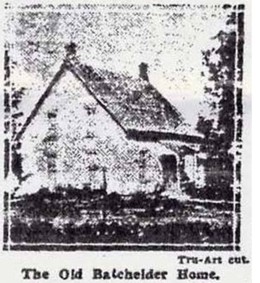 Monticello – If inert objects could speak, an interesting historical tale could be related by an old brick and wooden house now occupied by the Fred Ortgies family, one and one-half miles southwest of Langworthy in Jones County.